

Reading shampoo labels
The front sells. The ingredient list tells.
Disclosure: We may earn a commission if you buy through links on this page. It does not change what we recommend. Affiliate Disclosure
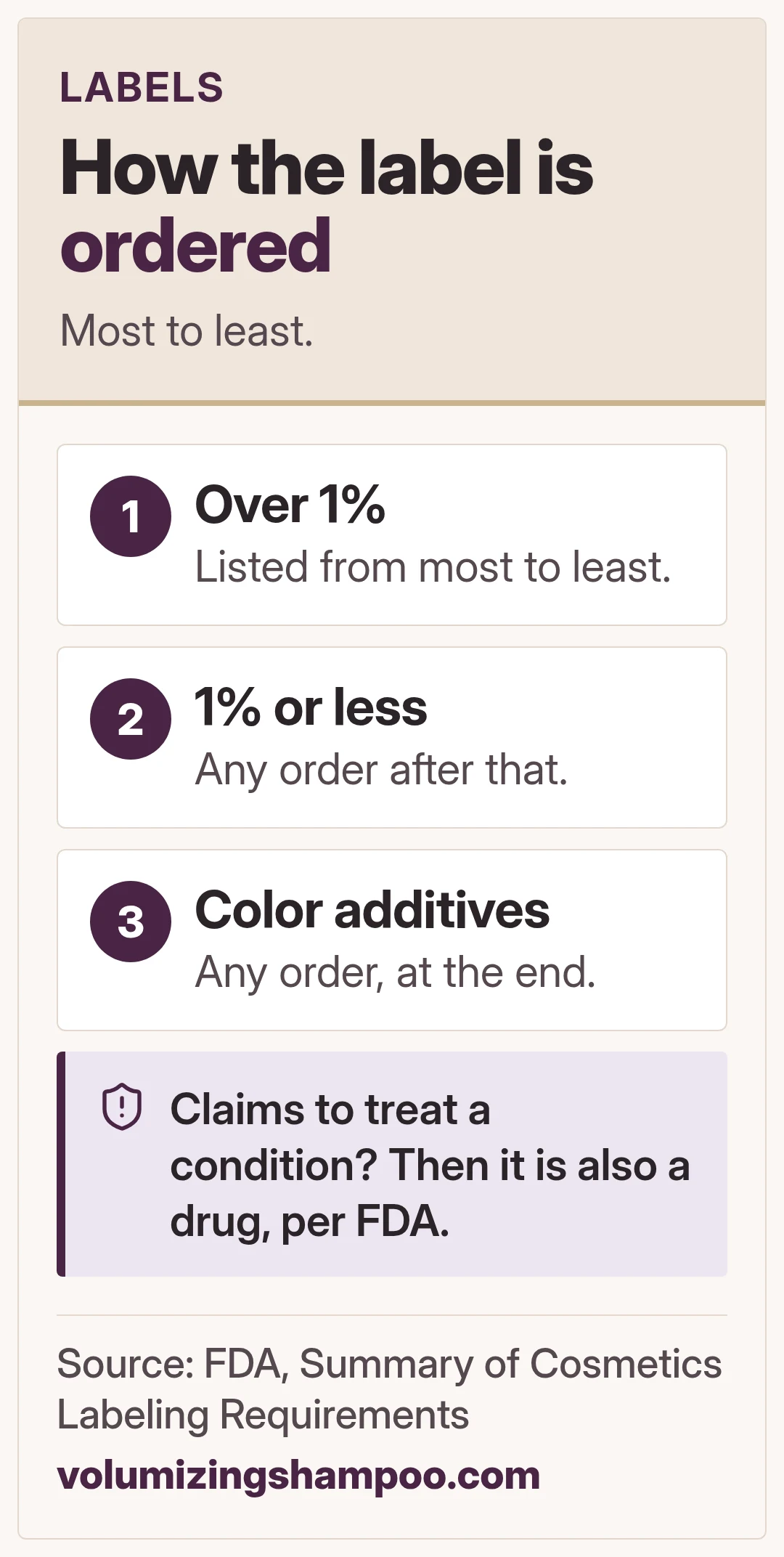
The ingredient list is in order
Under FDA rules, cosmetic ingredients are listed in descending order of how much is in the product. Ingredients at 1% or less, and color additives, may be listed in any order after the rest.
Front of the bottle words
"Volumizing", "thickening", "lightweight", and "for fine hair" are the brand's descriptions. They are not standard terms with a set meaning.
When a shampoo is also a drug
Under FDA rules, a shampoo marketed to clean the hair is a cosmetic. A shampoo meant to treat a condition, such as dandruff, is also a drug. A product that claims to restore hair growth is a drug.
"Ingredients to avoid"
There is no single list that suits everyone. If an ingredient has irritated your scalp before, look for it on the list. Patch test new products. If a product causes a reaction, stop using it, contact a health care provider, and you can report it to the FDA.
Cosmetics are not approved before sale
Except for color additives, the FDA does not approve cosmetics before they go on the market. The maker is responsible for the product's safety and labeling.
FAQ
General information, not medical advice. Patch test new hair products, keep them out of your eyes, and stop use if irritation occurs. See a doctor or dermatologist about scalp conditions or hair loss.
Now know your hair
The right label depends on your hair type.
